



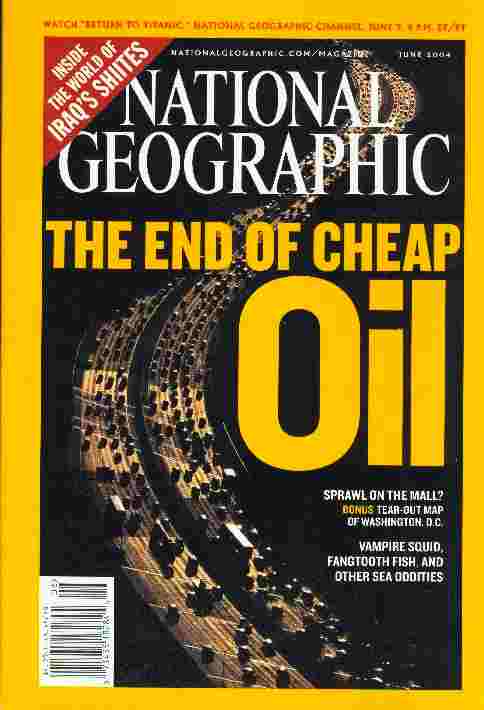
 Peak Oil
the real connection between Iraq and 9/11
The most important question facing the human race is how we respond to the interconnected crises of Peak Oil, Climate Change, overpopulation, and resource conflicts.
How we use the remaining oil will determine what the “post carbon” society will be:
- do we “spend” it on solar panels or battleships?
- on relocalizing food production or further “globalization” of production?
- more superhighways or better trains?
- more coal, oil and nuclear, or more renewable energy systems?
The global crises of the end of cheap oil and the start of climate change require global levels of solutions (relocalize everywhere). We are not merely at peak oil, we are at peak technology, peak money, peak communication. Real solutions would require us to redirect the energy, talents, resources of global capitalism, the military industrial complex, universities, media and other pillars of our society.
 We have enough resources and talent to shift civilization to create a peaceful world that might be able to gracefully cope with the end of concentrated fossil fuels, or to create a global police state to control populations as the resources decline. We don't have the ability to have a peaceful world while embarking on a World War over the last of the fossil fuels that power civilization.
This is a simple question that has a complicated answer - since these decisions were not made democratically. Understanding why civilization did not respond to the warnings of resource depletion decades ago is needed if a shift toward sanity is still possible at this late date.
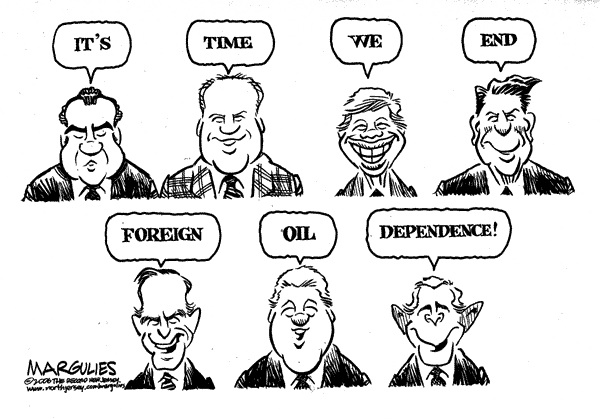
We are not "addicted" to oil -- the modern world is completely dependent upon it for our industrial agriculture systems, our transportation networks, and the global economy. Addictions are things you can give up -- but oil runs our civilization.
Peak oil, minerals depletion, deforestation, depletion of fisheries, soil degradation, toxic and nuclear waste, declining per capita food production, desertification, climate change, ultraviolet radiation increases, overpopulation, declining natural gas extraction, the limits to growth on the electric grid and other "critical infrastructure" -- these and many other facets of our overload on the planet are natural limitations on the cancer-like endless growth of industrial civilization.
| a turning point for industrial civilization |
The most important question facing the human race is how we respond to the interconnected crises of Peak Oil, climate change, overpopulation, and other resource conflicts.
How we use the remaining oil determines
the future of the human race:
do we “spend” it on solar panels or battleships?
on relocalizing food production or further “globalization” of
production?
more superhighways or better trains and transit?
more coal, oil and nuclear, or more renewable energy systems?
This is a simple question that has a complicated answer - since these decisions were not made democratically. Understanding why civilization did not respond to the warnings of resource depletion decades ago is needed if a shift toward sanity is still possible at this late date.
"No civilization can survive the physical destruction of its resource base."
-- Bruce Sterling
Connecting the Peak Oil dots
These crises resemble the parable of the blind men touching an elephant. Each observer is correctly describing what a part of the elephant is, but none have a holistic understanding. Peak Oil and Climate Change are two facets of the problem of overshoot, and neither can be mitigated in isolation from the other.
Peak Oil and Climate Change can only be addressed in combination, trying to tackle one without the other is a proven failure. Efforts to deal with Peak without Climate awareness leads to tar sands, coal to liquids and other eco-disasters. Efforts to deal with Climate without Peak fail to understand what is happening, and rarely consider how dependent our food system is on concentrated fossil fuels.
Focusing solely on oil depletion leads to destructive policies aimed at increasing liquid fuels production -- “alternative” fuels that can have worse environmental impacts than conventional petroleum, including accelerated climate change.
Concern about melting glaciers and extinction of charismatic megafauna is less likely to influence governmental energy policies than desperate scrambles to replace depleting fossil fuels.
Most projections of future carbon levels ignore the fact that fossil fuels are finite. Focusing solely on climate change ignores the most important question facing humanity -- whether to "spend" the remaining oil on solar panels or battleships (a simplified version of the choice).
This is the way that carbon emissions are going to be reduced, not through voluntary simplicity nor offset campaigns. Efforts to “reduce carbon by 2050” are a subtle way to acknowledge Peak Oil.
Peak Oil was the primary motive of the Bush regime for allowing and assisting the attacks. Without 9/11, it would have been impossible for the US to invade Iraq and take over their oil fields, which gives the US a dominant military position in the middle of the world's main oil production region as we pass the point of Peak Oil.
The first cabinet meeting of the Bush administration (after they stole the White House) included discussion of how they were going to attack Iraq. In the spring of 2001, the Cheney energy task force included examination of maps of Iraqi and other Persian / Arabian Gulf oil fields and which companies had drilling rights. Vice President Cheney was on record as knowing about Peak Oil before entering the White House, and presumably the oil company connected officials in their administration were also aware of this basic fact. The energy task force happened around the same time that warnings that 9/11 was imminent were pouring into the White House from close US allies and even from within the FBI (which had agents tracking the flight schools that some of the perpetrators were training at).
Peak Oil and 9/11 complicity are inseparable issues, even if most who focus on one or the other chose to look at them in isolation from each other.
Iraq, Iran, former Soviet Georgia, Africa and others. The US empire is playing a "Good cop / bad cop" strategy where the neo-cons wrecked Iraq but the neo-liberals are in agreement that Iraq should be partitioned (which would allow the US greater control over the oil). If the bulk of the remaining oil was in places that were predominantly Buddhist or Hindu, the US would be waging a war on Buddhism or Hinduism.
Peak Oil and the media
neither the mainstream (corporate funded) media nor the alternative (foundation funded) media chose to highlight Peak Oil before the peak. The media is slowly doing more stories about Peak Oil, although it took the War on Iraq, rising gasoline prices and grassroots awareness of Peak Oil to force this slow shift. The media does not show how Peak Oil was the motive for the Bush / Cheney war crimes in the Middle East and 9/11.
Peak Oil and Homeland Security
The best analyses of Peak Oil and of global warming each conclude that the problem would have to be addressed a decade or two before it manifests at full strength - yet both problems are here, now. Perhaps the truth is that the shadow government (corporations and the military industrial complex) did not want to deal with these problems because the solutions are inherently decentralized and would require relaxation of centralized power control systems. Since we missed the opportunity to solve these issues as gently as possible, governments are instituting a global surveillance police state to suppress dissent as the oil that runs the show becomes more scarce and expensive, and climate change reduces available food and water supplies.
President Carter made modest efforts to start shifting from total dependence on oil, but his administration was toppled in a virtual coup d'etat by the national security state. The Clinton / Gore administration had nice rhetoric on the environment, but gave us energy deregulation, SUVs and NAFTA superhighways instead of renewable energy, hyper-efficient cars, and a European quality passenger train system. Bush and Cheney are on record as aware of Peak Oil, but chose to direct the federal government toward policies that merely benefit the wealthiest, some of whom are looting what they can as their preparation for the end of cheap fossil fuels. In their view, renewable energy is for the rich and powerful, and is increasingly in use by the military - Guantanamo concentration camp has wind turbines to supply some of its electricity.
The 2008 Presidential contest featured two flavors of nonsense about energy from John McCain and Barack Obama - neither mention Peak Oil in their distracting sound bites about how much to drill in the US (a place that peaked nearly four decades ago). Even independent candidate Ralph Nader claims that more refineries need to be built to lower oil prices, although oil companies will not invest in facilities to process oil that does not exist (the only new refineries likely to be built in the US will be for "unconventional" oil from heavy "sour" oil, tar sands, coal to liquids and other gunk not otherwise usable in cars and trucks and planes).
www.registerguard.com/news/2006/02/12/ed.letters.0212.p1.php
Register-Guard, letters to the editor
February 12, 2006
Face it, oil is a finite resource
Economics professor Bill Harbaugh's Feb. 3 guest viewpoint, "Proponents of the peak oil theory crying wolf - again," reminded me of the quip that an economist is someone who thinks a tree can grow all the way to the moon if given enough money.
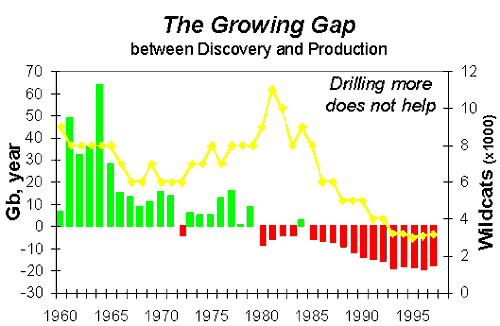
Energy creates money, not the other way around. One cannot merely find more oil by drilling more if the deposits in the Earth have largely been mapped already. World discoveries of oil peaked around 1962, and despite tremendous technological advances, the amounts found in recent years have been small compared with daily consumption.
A peak oil analogy for Oregonians is the decline of the logging and mining industries because the resource base was not infinite. Yes, there are politics, laws and economics involved, but the real issue is that the Earth is round and therefore finite. Trees do grow back, in time, but not at the rate that we wish to use them. Mineral ores are a use-once resource.
None of the alternatives to oil cited by Harbaugh have the same energy density as petroleum. Some of the alternatives are wonderful - I'm using solar electricity to type this - but they can not replace our greed and careless overconsumption.
Exponential growth and a finite planet are incompatible concepts. If we want civilization to continue, shifting economics, politics and psychology away from fantasies that endless expansion is possible is a first step toward a sane energy policy. Some strategies are outlined at permatopia.com
MARK ROBINOWITZ
| We are not "addicted" to oil: we are dependent upon it |

Fossil Fuel Junkies at Wall Street, New York
City, Earth Day 1990
we are addicted and we have to get off of oil - eroei means this is difficult, we are dependent, population increases due to concentrated energy - it's a clue that bush said this
All civilizations are ultimately dependent on natural resources.
We are dependent on oil for our civilization to function - it is not an "addiction."
If we stop using fossil fuels our industrial civilization will collapse and the ensuing chaos could lead to global wars that would wreck the biosphere. If we continue to use fossil fuels, the pollution will continue to foul the world and create more resource conflicts. Damned if we do, damned if we don't. Solving these problems is the greatest challenge ever faced by our species.
There is a possible, positive future after Peak Oil, but the blind faith in technological exuberance is not going to get our society to make the substantial shifts to relocalize production, live much more simply, and take responsibility for our bioregions.
The world will only behave rationally if we have the courage to stare into the abyss and demand a permaculture, relocalization alternative to global fascism and omnicide.
James Howard Kunstler, author of “The Long Emergency,” explains why “energy independence” is an illusion if it involves maintaining our American Way of Life.
www.kunstler.com/mags_diary19.html
November 13, 2006
The day after the impressive Democratic election victory, Senate Majority Leader-to-Be Harry Reid declared that a top priority for the new congress would be policy leading to “energy independence” for America. The time of jubilee will certainly come, but not in the way Harry Reid thinks it will -- nor in the way the rest of the country imagines this idea.
When politicians flog the term around -- “energy independence” -- they invariably mean that we will continue enjoying the happy motoring utopia by other means than imported oil (which makes up 70 percent of all the oil we burn). Get this: the day is not far off when, for one reason or another, the flow of imported oil to the US will cease. But when that day comes, we will not be running our shit the way we have been running it. That day will be the end of the interstate highways, Walt Disney World, and Wal-Mart -- in short, the way of life we are fond of calling “non-negotiable.”
food
transportation
global economy
petrodollars
Beyond Oil? energy independence can't fuel American Way of Life (AWOL)
Solar, Wind, Biofuels and other renewable sources require relocalization and restraint - renewables could power a stable state society not based on exponential growth
James Howard Kunstler explains why "energy independence" is an illusion if it involves maintaining the American Way of Life
http://kunstler.com/mags_diary19.html
James Howard Kunstler
November 13, 2006
The day after the impressive Democratic election victory, Senate Majority Leader-to-Be Harry Reid declared that a top priority for the new congress would be policy leading to "energy independence" for America. The time of jubilee will certainly come, but not in the way Harry Reid thinks it will -- nor in the way the rest of the country imagines this idea.
When politicians flog the term around -- "energy independence" -- they invariably mean that we will continue enjoying the happy motoring utopia by other means than imported oil (which makes up 70 percent of all the oil we burn). Get this: the day is not far off when, for one reason or another, the flow of imported oil to the US will cease. But when that day comes, we will not be running our shit the way we have been running it. That day will be the end of the interstate highways, Walt Disney World, and WalMart -- in short, the way of life we are fond of calling "non-negotiable."
Alternatives to oil
www.inthewake.org/savinar1.html
Matt Savinar, LifeAfterTheOilCrash.net
People tend to think of alternatives to oil as somehow independent from oil. In reality, the alternatives to oil are more accurately described as "derivatives of oil." It takes massive amounts of oil and other scarce resources to locate and mine the raw materials (silver, copper, platinum, uranium, etc.) necessary to build solar panels, windmills, and nuclear power plants. It takes more oil to construct these alternatives and even more oil to distribute them, maintain them, and adapt current infrastructure to run on them. ...
... it is still possible for the world economy to run on a basket of alternative sources of energy - so long as we immediately get all of the following:
- A few dozen technological breakthroughs;
- Unprecedented political will and bipartisan cooperation;
- Tremendous international collaboration;
- Massive amounts of investment capital,
- Fundamental reforms to the structure of the international banking system;
- No interference from the oil-and-gas industries;
- About 25-50 years of general peace and prosperity to retrofit the world's $45 trillion dollar per year economy, including it transportation and telecommunications networks, manufacturing base, and agricultural systems to run on these new sources of energy;
If we get all of the above, we might be able to get the energy equivalent of 3-5 billion barrels of oil per year from alternative sources.
That's a tremendous amount of oil - about as much as the entire world used per year during World War II, but it's nowhere near enough to keep our currently mammoth-sized yet highly volatile global economic system going. The world currently requires over 30 billion barrels/1.2 trillion gallons of oil per year to support economic growth. That requirement will only increase as time goes on due to population growth, debt servicing, and the industrialization of countries like China and India.
So even if the delusionally optimistic scenario described above is somehow miraculously manifested, we're still facing a full-blown meltdown of petrochemical civilization.
-- Matt Savinar, lifeaftertheoilcrash.net
20%
renewable energy in 2020? that won't replace depleted oil and gas |
Democratic Party and environmentalist goals for the transition ignore Peak Oil realities and the need for lifestyle changes
In 2004, Democrat presidential candidate Howard Dean had a position paper that recommends 20% renewable energy by the year 2020. This goal was probably determined by it illiterative qualities (20 - 2020), not energy requirements, since by that date, oil extraction outside the Islamic world will largely be over, natural gas in North America will be on the way out, and there will be nearly two billion more people clamoring for food grown with intensive energy inputs. In other words, the scale of the needed mobilization dwarfs even these proposals. (Dennis Kucinich was the only 2004 Presidential candidate who mentioned Peak Oil, supports the Kyoto treaty to reduce climate change and would completely eliminate all subsidies for fossil fuels, assuming that these could pass in Congress, an unlikely outcome without major changes in campaign finance laws and a reduction in the power of oil companies over both corporatist political parties.
Oil vs. Electricity
Fuel substitution and the naivete of the Democrats and establishment environmentalists - the example of the "Apollo Project"
A new political initiative called the Apollo Project seeks to get widespread support for renewable energy, claiming that this would create good jobs while reducing our dependence on imported oil. Unfortunately, it is a mix of good intent and poor math. It's shrewd to get union and political support for renewable energy projects. But putting up solar panels and wind turbines would reduce our dependence on COAL from Wyoming and West Virginia and NATURAL GAS from Alberta and Texas.
Massive increases in solar and wind could not reduce our dependence on imported petroleum.
1) The oil goes to transportation, not the electric grid (there are very few electric vehicles in the US, and almost no petroleum provides electricity) The electricity used for transportation powers oil refineries and distribution systems, automobile factories (those still in the country), subways and light rail systems in a few cities, and AMTRAK trains on the east coast (cross country AMTRAK trains are diesel powered).
2) Petroleum is used to keep our food system going -- pesticides, fertilizers (made from natural gas) and similar chemicals are fossil fuel derived. Even organic food requires lots of fossil energy for tractors and food distribution and refrigeration and packaging. Food in America is a way of converting petroleum into usable calories.
3) solar panels and wind turbines would reduce the EQUIVALENT energy that is imported from the Middle East. But the inability to substitute one form of energy for another means that even if 100 or 200 gigawatts of solar panels were put on rooftops all over the country, this would barely impact our dependence on Mid East oil.
4) Solar and wind cannot power 757s, aircraft carriers, Stealth fighter planes, Army tanks and similar "critical infrastructure."
5) The US entire economic system is based on endless growth in the monetary supplies (the biggest "pyramid scheme" in history), pricing petroleum in petrodollars (not petro-Euros) and dominating the energy supplies of our economic competitors.
Any energy proposal such as "Apollo" that ignores the reality of Peak Oil is doomed to be woefully inadequate. Good intentions aren't going to be enough for dealing with the crisis of civilization. Nice rhetoric about "reducing dependence" is a good thing but unlikely to solve the problem. Solutions that maintain the illusion that "economic growth" can be continued on a planet with finite resources are unlikely to work - we need to shift away from growth based economics.
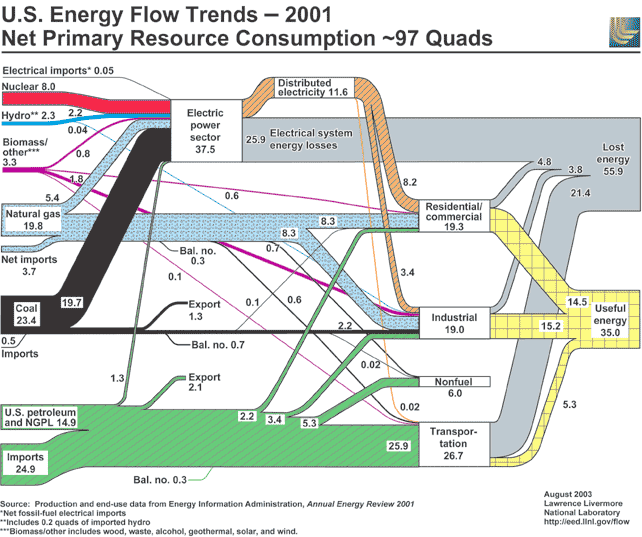
this chart from the Department of Energy shows that coal, oil, nuclear, hydro and petroleum energy sources are difficult to substitute for each other - coal and nuclear do not run transportation or directly heat buildings, and very little petroleum powers the electric grid. Natural gas is one of the only energy sources that serves multiple uses, but it is largely irrelevant to transportation - and there isn't enough gas to heat buildings and run industry while building more and more new natural gas power generation facilities.
This chart also shows that a majority of energy generation in the US is wasted through inefficiency. A serious national effort for energy efficiency would buy us a little time to make the transition to a more locally oriented, renewable energy society.
| Energy Independence would require changes in the way we live |
Solar, wind, biomass and other technologies could only make the US achieve "energy independence" if Americans were to radically reduce energy consumption. These steps would include
- abandoning jet travel (which won't be powered by windmills or solar cells),
- eating food locally and in season (which will be difficult given the near total amnesia in our society about how to grow food or even where food comes from),
- abolition of synthetic nitrogen fertilizer that grows most of our food (it's made from natural gas),
- a shift to a largely vegan diet (which uses much less energy, especially if the consumers are in metropolitan areas far removed from the farms)
- a massive reduction in electricity consumption and
- restructuring communities to end long-distance daily commutes.
Peak Oil will radically change human civilization. Ignoring it as an issue -- until the panic sets in -- means that careful planing to cope with the crises and to use some of the oil as a "bridge" toward a more local, lower energy sustainable society is less likely.
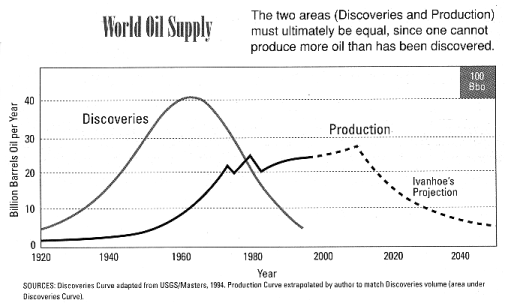
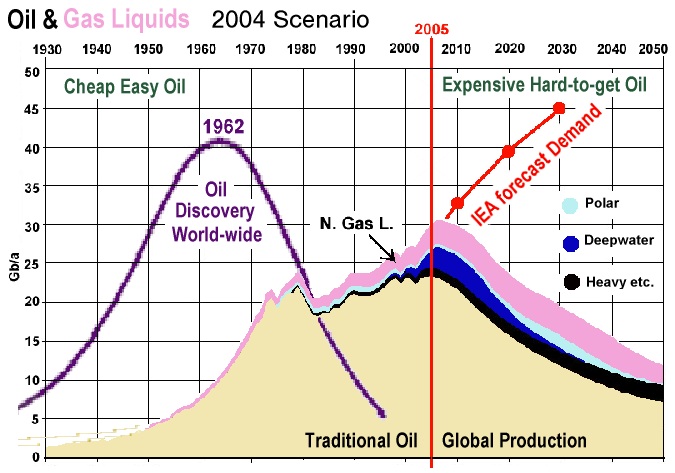
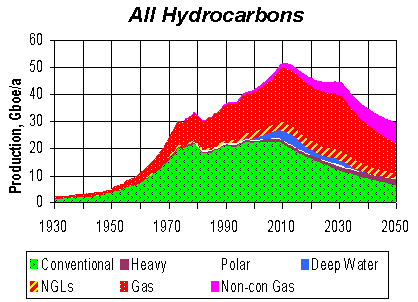
for conventional, recoverable oil
(tar sands in Canada take nearly as much energy to extract as they contain)
| OPEC / non-OPEC crossover point |
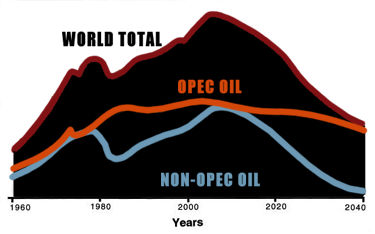
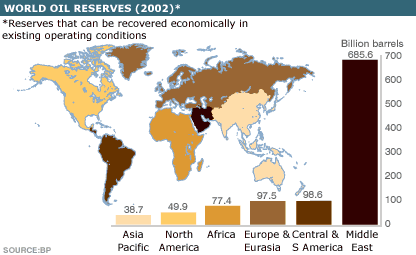
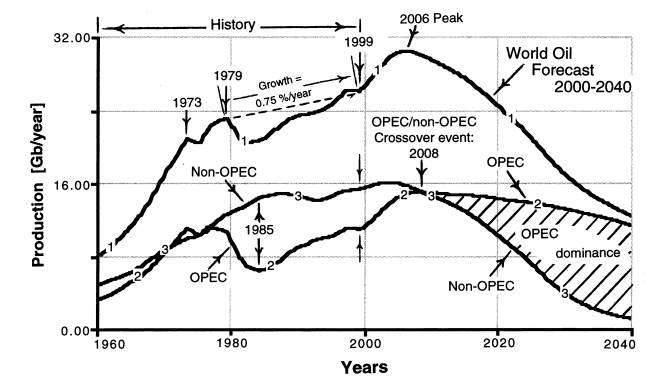
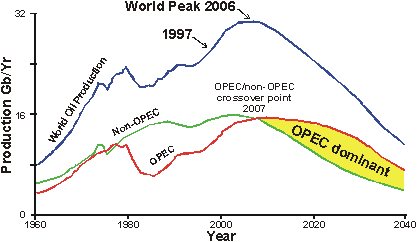
Petroleum geologists project that the "OPEC / non-OPEC crossover point" - the point when the majority of the world's oil production will be from the Organization of Petroleum Exporting Countries - will be reached around the same time as the global peak of total oil production. After the crossover point, as oil supplies dwindle from the US, the North Sea and other non-OPEC locations, control of OPEC oil - and therefore control of the global economy - will be even more critical for continued US economic, political and military hegemony.
| Low Hanging Fruit: Embedded Energy |
Some technophiles claim that Peak Oil is exaggerated because there is a lot of "ultimately recoverable" oil (the site www.radford.edu/~wkovarik/oil/index.html is a good example of this). It misses the real point: "ultimately recoverable" is not a measure of how much energy potential is in the oil. The cheap, easy to get at oil is what is the real issue. If you have an apple tree that is forty feet tall and it takes a lot of energy for you to climb that tree to get the apples at the top, there's not much energy value in climbing to the top to get the "ultimately recoverable" apples. The issue, from a calorie perspective, is eating the apples that take very little energy to retrieve.
The site listed here is correct in one aspect -- tar sands in central Canada contain LOTS of oil. But, it takes almost as much energy to extract and process it as they contain -- and the process requires a small ocean of fresh water (turning it into hazardous waste), a resource that is more important than petroleum. These "tar sands" are barely a source of energy, even if they are "ultimately recoverable."
But even if that site's glaring omissions are overlooked, it doesn't negate the reality of Peak Oil -- merely shifts the timing of the peak back perhaps another decade or two. And it omits any mention of the peak in North American natural gas extraction, which is probably going to hit harder and faster than the peak of petroleum.
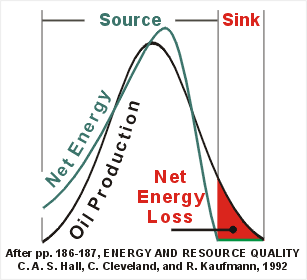 The issue isn’t when the oil "runs out" - but
when the existing oil becomes too difficult to extract. Not all
oil is equal - some takes very little to pump out of the ground and process
into gasoline and other products (especially the Persian Gulf oil fields).
The issue isn’t when the oil "runs out" - but
when the existing oil becomes too difficult to extract. Not all
oil is equal - some takes very little to pump out of the ground and process
into gasoline and other products (especially the Persian Gulf oil fields).
Other oil fields require much more energy to lift out of deep deposits (especially oil fields in the ocean) or are of lower quality, and have less “energy return for energy invested” We used to get about 50 barrels for every barrel put into the system, now it is about 5 to 1. When the ratio drops to one to one, it won’t matter if gasoline is $1,000 per liter - it won’t be a source of energy anymore.
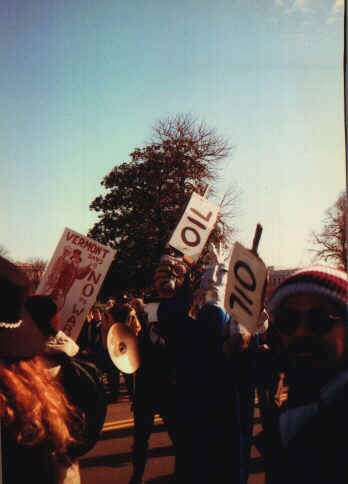
Washington, D.C., January 26, 1991